Saturday, December 8, 2012

Saying sorry

As I sat on the pew outside the confessional, waiting my turn, I was nervous to say the least.  I had recollected my failings, my sins, and was ready.  But my stomach was a ball of knots.  One by one the people sitting on the pew between me and the confessional room door got up to enter it as the person ahead of them exited.  One older man came out with tears in his eyes. 

Finally, it was my turn.  Ok, here I go, I thought.

I entered the room, closed the door behind me and knelt before the confessional screen.  I crossed myself and began, "Bless me father, for I have sinned."  At that point the penitent is supposed to say My last confession was . . .  However, I had only just entered the Catholic Church a few months previously.  "This is my first confession, father," I explained.  "I entered the Church this past Easter Vigil."  From the other side of the screen came Father John's cheerful voice, "Hey, welcome to Mother Church!"

Father John was our pastor at Saint Elizabeth Ann Seton parish at that time.  He is a good and popular priest. 

The sound of his voice calmed me down a lot.  I won't divulge the tawdry sins I confessed or the counsel Father John gave me.  But it was wise counsel and I remember it to this day. 

What I also remember is the sense of joy and release I felt afterwards.  I feel this after every confession I make.  On another occasion after confession, while driving home from the church, I broke into tears of gratitude in the car.


My readers who are not Catholic may ask these valid questions: Why not just confess your sins directly to God?  Why go to a priest in confession?

The Church is the body of Christ.  When we commit sin it is an offense against God and against his body the Church and so we must be reconciled with the Church.  There are no victimless sins.  Our sins not only damage our relationship with God but, one way or another, damage our relationships with other people.  When we wish somebody would just drop dead; when we waste our time and talent on selfish pursuits; when we look at dirty pictures that portray women has mere sexual objects, etc., we tear the fabric that connects us to other people.  By doing these things we kill love.  No man is an island, goes the line from John Donne.

I mentioned the counsel that Father John gave me during my first confession.  We go to a doctor when something ails us physically.  Some go to psychologists when something ails them mentally or emotionally.  When we're spiritually ill, we also need to seek help. 

The priest, as a representative of Christ, grants the penitent absolution in the name of the Father, Son and Holy Spirit.  Whatever personal shortcomings the priest has - and hey, they're human - he is still a channel through which God pours his graces.  The knowledge that Jesus on the cross looked into the abyss of human sin, at my sin and yours, and emptied his veins in order to wash us clean by his most precious and holy blood; and that he instituted the sacrament of penance where we can be granted forgiveness, creates a light-heartedness in me after confession like nothing else can.

For Scripture verses supporting Jesus' conferring power upon the Apostles to forgive sins, see Matthew 16:19, Matthew 18:18, John 20:21-22.  The Catholic bishops are the successors of the Apostles through the laying on of hands.  The bishops in turn ordain priests through the laying on of hands to act with the bishop's authority.  (1 Timothy 4:14, 2 Timothy 2:2 and others)

                                     The Beheading of Saint John the Baptist

John the Baptist, Advent prohpet


Second Sunday of Advent

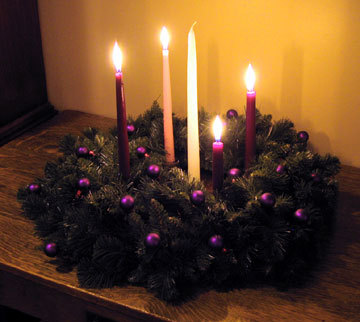
Purple is the color of Advent because it is the color of penitence.  As a time of preparation for the coming of Christ, Advent is a penitential season.  The second Sunday of Advent focuses especially on the theme of repentence.  Our Gospel reading for this Sunday is Luke 3:1-6 which includes the words, John (the Baptist) went throughout the whole region of the Jordan, proclaiming a baptism of repentence for the forgiveness of sins.

John the Baptist is the Advent prophet.  His purpose was to prepare the way for the Christ. 

These lines from the Psalm this Sunday, Psalm 126, relate how I and many others feel after confession, Restore our fortunes, O Lord, like the torrents in the southern desert.  Those who sow in tears shall reap rejoicing.

The Greek Orthodox have given us the Jesus Prayer.  It's a short, simple prayer and is a good one to have constantly on our lips - not only during Advent but always:

Lord Jesus Christ, Son of God, have mercy on me, a sinner.

 
* * * * * * *

Jazz pianist and composer Dave Brubeck died this past week, on December 5th, one day before his 92nd birthday.  Most people know him from his piece 'Take Five'.  About 10 years ago I bought the CD Time Out which the Dave Brubeck Quartet recorded back in 1959.  When we moved from Poland to Texas and then later back to Poland, that CD made both moves with me.  I've played that CD over and over through this past decade and I never grow tired of listening to it.  I only learned after his death that Brubeck had entered the Catholic Church in 1980 and had written a Mass. 

Rest in peace with the Father, Mr Brubeck.  Your music continues to give me immense pleasure.


Saturday, December 1, 2012

He is coming

This past Sunday, on the feast of Christ the King, we had the following readings at mass: Daniel 7:13-14, which includes the words On him was conferred sovereignty, glory and kingship; Psalm 92, where we sang the refrain The Lord is king, with majesty enrobed; Revelation 1:5-8, which includes the words Jesus Christ is the faithful witness, the First-born from the dead, the Ruler of the kings of the earth; concluding with the Gospel reading from John 18:33-37, where we see Jesus at his criminal trial before Pontius Pilate.  Are you the king of the Jews? Pilate asks.  Jesus answers, Yes, I am a king.  I was born for this, I came into the world for this: to bear witness to the truth; and all who are on the side of truth listen to my voice.

The first 3 readings reflect Jesus Christ the king in his spendor and majesty.  The Gospel reading shows Jesus seemingly powerless, standing before the Roman governor of Judea.  Remember that the Roman governors represented the Roman emperor.  The emperor held the power of life and death over all of his subjects.  His decrees were final.  The Roman people looked on the emperor as one divine; as a god.  The governors, as representatives of the divine emperor, likewise held the power of life and death over their local subjects. 

And so we see Jesus the Christ, creator of heaven and earth, standing meekly before a mere temporal power.  Thus ends the Church's liturgical year. 

Our King
Advent

On December 2nd we begin the season of Advent (which means arrival) where we contemplate on and prepare for the coming of Jesus Christ - both at the end of time and at his first coming, as a helpless infant in Bethlehem.

The days are coming, says the Lord, when I will fulfill the promise I made to the house of Israel and Judah. In those days, in that time, I will raise up for David a just shoot.  That begins the first reading this Sunday, from Jeremiah 33:14-16.  We continue with Psalm 25 with the refrain To you, O Lord, I lift my soul; 1 Thessalonians 3:12 - 4:2 May the Lord make you increase and abound in love for one another . . . strengthen your hearts . . . be blameless in holiness before our God and Father at the coming of our Lord Jesus Christ with all his holy ones; and Luke 21:25-28, 34-36 Jesus said to his disciples: "There will be signs in the sun, the moon, and the stars, and on earth nations will be in dismay . . . People will die of fright in anticipation of what is coming upon the world . . . Beware that your hearts do not become drowsy . . . and that day catch you by surprise like a trap . . . Be vigilant at all times and pray that you have the strength to escape the tribulations that are imminent and to stand before the Son of Man."

Advent is a beautiful season meant for quiet reflection and anticipation of the coming of Christ.  Hope and waiting are the overarching themes of the season, but each of the 4 Sundays of Advent has its own particular theme.  Hope and vigilance are the themes for the first Sunday, repentence for the second Sunday, joy for the third Sunday, while on the fourth Sunday we are nearly bursting with anticipation of the birth of Christ. 

There are some lovely Advent traditions.  One of my favorites is the lighting of the Advent wreath each Sunday at mass.  The green Advent wreath (green symbolizes hope) has four outer candles and one inner candle.  On the first Sunday of Advent the first candle is lit, on the second Sunday the first and second candles are lit and so on.  Typically 3 of the outer candles are purple (the color of penitence and fasting as well as the color of royalty to welcome the advent of the King) and one is rose or pink colored.  Rose is the color of joy and this candle is lit on the 3rd Sunday.  The center candle is white, representing Jesus Christ, and is lit during the midnight mass on Christmas Eve.

Saturday, November 24, 2012

Christ the King

I gazed into the visions of the night.  And I saw, coming on the clouds of heaven, one like a son of man.  He came to the one of great age and was led into his presence.  On him was conferred sovereignty, glory, and kingship, and men of all peoples, nations and languages became his servants.  His sovereignty is an eternal sovereignty which shall never pass away, nor will his empire ever be destroyed.  Daniel 7:13-14

 
On Sunday the 25th of November, the Catholic Church celebrates the feast "Our Lord Jesus Christ, King of the Universe," or "Christ the King" for short.  This celebration occurs on the final Sunday before the begining of Advent.  It is the end of the Church's liturgical year.
 
Kingship
 
The system of government known as monarchy- that is, kings and queens - has for the most part gone from the world.  For all of the pomp and pageantry surrounding the British royal family, the Queen of England really has no power. 

Perhaps that's a good thing.  Contemporary wisdom has it that democracy is the best form of government. 

In Republic, Plato says that tyranny arises, as a rule, from democracy.  There are various reasons for this.  The main reason is due to a lack of equality among people.  The "have nots" increasingly vote to seize and redistribute the wealth of the "haves."  This requires a larger government bureaucracy with its attendant rules and regulations.  The great mass of people tend to prefer security over liberty and we end up with a nanny state that guides and manages a greater part of our lives.

It's interesting when reading the histories of the times of monarchies to see how little a role national governments played in people's daily lives.  Most of the rules and obligations people faced were at the local level.  Taxes were much lower under those systems as well.  The American colonists payed much less in taxes under King George than Americans pay in taxes today.  Hmm . . .


Christ the Judge, from Michelangelo's Final Judgement, Sistine Chapel


The End of Time

I can't imagine Jesus Christ being referred to as Christ the President, or Christ the Governor, or the CEO or mayor.  As Creator of all that is visible and invisible (Colossians 1:16), all power and authority are His.  Satan is allowed time to prowl the earth, "seeking whom he may devour" (1 Peter 5:8).  But Jesus promised to return at the end of time and put a final end to sin and death.

During these final 2 weeks of the Church's liturgical calendar, we get a healthy dose of daily mass readings from the books of Daniel and Revelations concerning the end of time.  We are asked to reflect on the Four Last Things: Death, Judgement, Hell and Heaven.

Traditionally, human kings were lawgivers as well as final arbiters of justice.  In that sense, Jesus Christ is the perfect and ultimate King.

This anticipation of the return of Jesus Christ will carry over into the season of Advent.  Advent means "arrival" and during that season we will not only prepare to celebrate Jesus' birth, or arrival, at Bethlehem, but we look to his second and final coming at the end of time.

There's a lot of chatter about the end of the world occuring on December 21st 2012.  Apparently that date marks the end of the Mayan long calendar which signals the end of an age.  People should know that serious Mayan scholars dispute this.  (Also remember two things: the Mayans practised human sacrifice where their priests cut open the victim's chest and tore his heart out; and the Mayan civilisation collapsed.  How much authority should we credit them with?)  There's quite a bit of new age stuff about "galactic realignment" and "timewave zero" that also focus on the date December 21st.  Go to Wikipedia and take a wild ride through all that.

I think since Jesus Christ is the Universal King, He should have the final word on this: Jesus said, "In those days, after the time of distress, the sun will be darkened, the moon will lose its brightness, the stars will come falling from heaven, and the powers in the heavens will be shaken.  And then they will see the Son of Man coming in the clouds with great power and glory; then too he will send the angels to gather his chosen from the four winds, from the ends of the world to the ends of heaven.  Take the fig tree as a parable: as soon as its twigs grow supple and its leaves come out, you know that summer is near.  So with you when you see these things happening: know that he is near, at the very gates.  I tell you solemnly, before this generation has passed away all these things will have taken place.  Heaven and earth will pass away, but my words will not pass away.  But as for that day and hour, nobody knows it, neither the angels of heaven, nor the Son; no one but the Father."  Mark 13:24-32

Saturday, November 17, 2012

The Holiday Racket

The two definitions that I have in mind for the word racket in this post's title are: confused clattering noise and a fraudulent scheme, enterprise, or activity. 

I'm referring to the holiday season now underway.  When I was a kid, the holiday commercials appeared on TV and many people put up their Christmas trees on or right after Thanksgiving.  Many people thought that was too soon.  Now at least part of Walmart is decked out for the holidays before Halloween. 

When Renata and I left Poland 9 years ago, the holiday season didn't kick off here until sometime in December.  But now in Poland it starts right after the 1st of November.


So, what's the problem?  A lot, in my opinion.  First of all it's ugly both visually and aurally.  I've not yet seen a large plastic inflatable Snowman, Santa and Grinch that I would consider beautiful.  I love Christmas carols and even the light-weight holiday songs like Rudolph the Red-Nosed Reindeer and Frosty the Snowman, but the never-ending quest for the novel and the silly has resulted in some horrendous versions of the old classics.  Do we really need the Chipmunks, redneck, rap and pop diva versions?  And do we need to hear them over and over at the shopping centers and on the radio for nearly two months?

That takes care of my confused clattering noise definition.  Now for my fraudulent scheme, enterprise, or activity definition. 

The retailers want us to buy, buy and buy some more for the holidays.  No matter that our closets are crammed full of junk we don't need (a lot of which was stuff we received at previous Christmases).  No matter that we wear our nerves to a thread trying to think of something to buy for everyone on our list and dealing with crowded and hyperactive stores and endless lines in the bargain.  No matter that many of us are already in some serious debt and shouldn't really be spending money on an unwanted battery-operated foot massager for some relative we haven't spoken 20 words to all year.  Nevermind that our children are chronically dissatisfied with the mountain of stuff we buy for them.

Do we think that the landfills aren't full enough?

Happy Holidays

I used to be one of those people who got upset when stores and people would wish us "Happy Holidays" rather than "Merry Christmas."  They're taking Christ out of Christmas! and all that. 

I've changed my tune on that.  As you can tell from my rant on the holiday season, I hold it in little regard.  I don't think the holiday monstrosity is worthy of the 'C' word. 

Advent begins on December 2nd this year. I'll have more to say on Advent on this blog in a few weeks, but suffice it to say it's meant to be a time of quiet, prayerful preparation for Christmas.  Actual Christmas begins on December 25th and traditionally was celebrated for 12 days after.  Those 12 days used to be the time for noisy merry-making.  Funny how now after the nearly 2 months of holiday season bedlam, the time between Christmas Day and New Year's Eve is a quiet, subdued period.

And then, of course, there's the matter of that troublesome Christ-child inconsiderately having a birthday in the middle of all this.

November

So, just ignore all the holiday season stuff if you don't like it, you old grump!  Believe me, I try to.  But it's not easy when everywhere you turn your senses are assaulted by it.

But anyway, it's November; a rather somber month in northern lattitudes.  Most of the trees are now bare and it hasn't yet snowed.  The days tend to be chilly, rainy and often foggy.

I've been looking for an excuse to include something in this blog by Robert Frost, one of my favorite poets.  So, here goes:

My November Guest
by Robert Frost

My sorrow, when she's here with me,
    Thinks these dark days of autumn rain
Are beautiful as days can be;
She loves the bare, the withered tree;
    She walks the sodden pasture lane.

Her pleasure will not let me stay.
    She talks and I am fain to list;
She's glad the birds are gone away,
She's glad her simple worsted gray
    Is silver now with clinging mist.

The desolate, deserted trees,
    The faded earth, the heavy sky,
The beauties she so truly sees,
She thinks I have no eye for these,
    And vexes me for reason why.

Not yesterday I learned to know
    The love of bare November days
Before the coming of the snow,
But it were vain to tell her so,
    And they are better for her praise.


Saturday, November 10, 2012

What now?

On November 6th a majority of the American voters decided they wanted 4 more years of President Obama.  So, what does this mean?  It means Obamacare kicks in next year, the national debt keeps increasing, it means taxes go up to try to pay for that debt, fuel prices continue to rise, unemployment remains high, religious freedom is attacked even more ferociously and America's standing in the world continues to erode.

The people who voted for Obama are either ok with that or they were incredibly ignorant when they cast their vote.  We're at a point where nearly half of the nation's adult population is either dependent on the government and/or thinks big government is the solution to all our problems.  Somehow a President who added more to the national debt in 4 years than any of his predecessors, lied continuously to the American people about what happened in the Benghazi attacks and invented the notion of a crisis in access to birth control in order to pick a fight with religious organizations was re-elected.  I see my country disappearing before my eyes.

America has been in decline for decades.  Obama is not the cause of this decline but a symptom of it.  I had hoped that maybe the 2012 election was our chance to slow down the decline; maybe even begin to turn the country around.  Some are saying we have passed a point of no return.  I'm afraid they may be right.


America's new Statue of Libertinism


* * * * * * *

"Going over the top" - World War I trench warfare

November 11th, Veterans' Day

November 11th, marking the end of the First World War in 1918, is celebrated in many countries.  In the USA it is Veterans' Day.  In Great Britain and other European nations involved in WWI it is Remembrance Day.  In Poland it is Independence Day, since the end of WWI meant the renewed independence of the country after 123 years of subjugation by foreign powers.

I remember when in school we used to have an assembly in the gymnasium to commemorate November 11th.  There were typically war veterans present, even some from WWI (those old guys have long since died).  At 11 a.m. we would all stand for a minute of silence since the First World War ended "at the eleventh hour of the eleventh day of the eleventh month."  There were always a few kids who whispered or giggled during this moment of silence, but most of us were respectful.  I always felt a strong wave of emotion at this moment.  It's hard to describe what my emotions were exactly: a mixture of patriotism, gratitude and grief for the fallen soldiers, I suppose.  I always hoped the other kids wouldn't see that my eyes had moistened up and so after the minute of silence I'd keep my eyes lowered to the ground and clear my throat a few times until I was "back to normal."  Oh, the anxieties of school days!

I have a slim volume of First World War poetry that I've been reading through this past week.  Many of the poets were soldiers in the war - and a lot of them died in battle.  Rudyard Kipling, famous for his novels Kim, The Jungle Book and others, lost his only son in that war and there are a handful of his war poems included.  The poems in the book range from enthusiastic and patriotic to bitter and disillusioned (sometimes from the same poet!).  There's plenty of beauty, tenderness, black humor, sadness, anger and resignation in this volume.

Frederic Manning was an Australian who had settled in England before the war.  At the age of 33, though in poor health (he'd been sickly since childhood), he managed to enlist in the British army and saw combat in France as a private in the infantry.  He survived the war and died in a nursing home in 1937.  Two of his poems from this volume are particularly touching for me as they deal with both the personal and universal in a profound way.  Feel free to see the relevance of 'The Sign' to our present day turmoil.  I do.

The Face

Out of the smoke of men's wrath,
The red mist of anger,
Suddenly,
As a wraith of sleep,
A boy's face, white and tense,
Convulsed with terror and hate,
The lips trembling . . .

Then a red smear, falling . . .
I thrust aside the cloud, as it were tangible,
Blinded with a mist of blood.
The face cometh again
As a wraith of sleep:
A boy's face, delicate and blond,
The very mask of God,
Broken.


The Sign

We are here in a wood of little beeches:
And the leaves are like black lace
Against a sky of nacre.

One bough of clear promise
Across the moon.

It is in this wise that God speaketh unto me.
He layeth hands of healing upon my flesh,
Stilling it in an eternal peace,
Until my soul reaches out myriad and infinite hands
Toward Him,
And is eased of its hunger.

And I know that this passes:
This implacable fury and torment of men,
As a thing insensate and vain:
And the stillness hath said unto me,
Over the tumult of sounds and shaken flame,
Out of the terrible beauty of wrath,
I alone am eternal.

One bough of clear promise
Across the moon.