Saturday, September 1, 2012

Deluges

I recently read a strange short story by the late Italo Calvino that got me thinking about floods and deluges.  This story is included at the end of this post. 

But first, a joke.  I heard this a few years ago in a homily by one of our priests back at St Elizabeth Ann Seton parish church in Keller TX, Father Jim:

In a little town in the hills of North Carolina was an old baptist church.  The church congregation was quite poor and they had very little money for church building upkeep.  It had been many, many years since the church was last painted and the weather-beaten wood on the outside of the church was looking pretty shabby. 

The church council decided that the church must finally be painted, but they only had funds enough to buy about half the paint needed for the job. 

One of the council members had an idea.  "Look," he said.  "If we mix the paint with a little bit of thinner, the paint'll go a lot further and we could probably paint the entire building." 

The other council members discussed this for a while and, as they had no other viable options, they decided to try the thinner idea.

So they bought the white paint and some thinner and one Saturday the council members painted the entire outside of their little church.  Then they all stood back to look.  The idea had worked.  The church looked like new, freshly clean and white.  They were very proud of their work.

During the night came a sudden downpour of rain, a real gullywasher.  The torrent of rain had the effect of causing the thinner-mixed paint to run down the side of the church. 

The next morning, being a Sunday, the council members arrived a little bit early for church service in order to view once again their proud accomplishment.  However they were horrified to see their previous day's work smeared down the sides of the church.  Their church looked even worse than before they painted it.

Now, the pastor of this little baptist church - Pastor Jebediah Sneed -  was a stern, elderly preacher.  The kind who preferred passages from Jeremiah, Ezekial or Job for his sermons.  The kind who would look grimly over his horn-rimmed glasses from the pulpit out to his congregation.  The kind whose thundering denunciations of sin caused you to squirm in your seat because you just knew he was talking about YOU. 

The rest of the congregation arrived to church and also stood there looking appalled at the state of their church building.  And that's when Pastor Sneed arrived.  He walked up to the front of the church, stopped and stood there quietly looking it over.  You could have heard a pin drop. 

After 30 seconds, without saying a word, Pastor Sneed walked up the front steps and into the church.  The congregation shuffled in quietly behind him.

Everybody took their places in the pews as Pastor Sneed walked up the aisle to the pulpit.  He stood there silently for a moment before thundering out:

"REPAINT YOU THINNERS!

GO FORTH AND THIN NO MORE!"


Noah's Ark

We all know the story of Noah's Ark: God's dissatisfaction with the sinfulness of the human race and determination to wipe it out, the exception of Noah and his family, God's instructions to Noah on how to build the Ark and what animals to save in it, the deluge and the 40 days spent in the Ark, the birds sent out to check if the waters had receded, Noah's offering to God afterwards. 

What is amazing are the parallels the Genesis story of the flood shares with numerous other flood stories in cultures from every inhabited corner of the world.  One of the earliest surviving works of literature is the ancient poem from the Mesopotamia region (modern day Iraq) called The Epic of Gilgamesh which includes a flood story in many ways similar to the biblical account.  The Ojibwe tribes of Minnesota have an ancient flood story that basically goes like this: "There came a time when the harmonious way of life did not continue. Men and women disrespected each other, families quarreled and soon villages began arguing back and forth. This saddened Gitchie Manido [the Creator] greatly, but he waited. Finally, when it seemed there was no hope left, Creator decided to purify Mother Earth through the use of water. The water came, flooding the Earth, catching all of creation off guard. All but a few of each living thing survived." Then it tells how Waynaboozhoo survived by floating on a log in the water with various animals.  http://nwcreation.net/noahlegends.html

Obviously some cataclysmic flood for floods happened a very long time ago.  There are various naturalistic explanations put forth, such as major earthquakes that unleashed great inland seas into lower lying areas or that caused great tsunamis that flooded large areas of land, or even a meteorite that crashed into the Indian Ocean around 3000 BC that created the 19 mile wide undersea Buckley Crater and that a generated a massive tsunami. 

The Deluge by Gustave Doré
 
In my previous post I stated how Christians view history as a linear progression puncutatedby a line from above, giving the appearance of a cross, this vertical line representing God who transcends human history entering physically into human history through the Incarnation of Christ.  All events in human history before and after this event are in relation to it. 

Regarding the flood and Noah's Ark, Christians see this as symbolic of Christian baptism.  The flood wiped away sinful humanity leaving the good remnant of Noah and his family.  The waters of baptism wipe away sin and lead us into life in Christ. 

Likewise, Christians also see the parting of the Red Sea whereby the Israelites were saved and their pursuers, the Egyptians, were destroyed as the waters surged back together as symbolic of baptism.


Good for Nothing
by Italo Calvino

Already high, the sun shone obliquely into the street, lit it confusedly, projecting shadows from the roofs on to the walls of houses opposite, kindling fancy shop windows in dazzling gleams, popping out from unsuspected cracks to strike the faces of people bustling past each other on the crowded pavements.

I first saw the man with the light-coloured eyes at a crossroads, standing or walking, I can't rightly recall: he was getting nearer and nearer to me, that's for sure, so either I was walking towards him or vice versa. He was tall and thin, wore a light-coloured raincoat, and carried a tightly rolled umbrella hanging neatly from one arm. On his head he had a felt hat, once again light-coloured and with a wide round brim; immediately beneath were the eyes, large, cold, liquid, with a strange flicker at the corners. Thin as he was, with close-cropped hair, it was hard to tell how old he might be. In one hand he held a book, closed, but with a finger inside, as if to keep his place.

Immediately, I had the impression that his eyes were upon me, motionless eyes that took me in from head to toe, that didn't spare my back either, nor my insides. I looked away at once, but every few steps as I walked, I felt the urge to dart a glance at him, and each time I would find him nearer, and looking at me. In the end he was standing in front of me, an almost lipless mouth on the point of creasing into a smile. The man pulled a finger from his pocket, slowly, and used it to point downwards to my feet; it was then that he spoke, with a thin, rather humble voice.

'I beg your pardon,' he said, 'your shoelace is undone.'

It was true. Trodden and bedraggled, the two ends of the lace dangled at the sides of my shoe. I blushed a little, mumbled a 'Thank you', bent down.

Stopping in the street to tie up a shoe is annoying: especially when you stop as I did in the middle of the pavement, without a step or wall to put my foot on, kneeling on the ground, with people knocking against me. The man with the light-coloured eyes muttered a vague goodbye and went off at once.

But it was destiny that I should meet him again: not a quarter of an hour had passed before once again I found him standing in front of me, looking in a shop window. As soon as I saw him I was seized by an inexplicable urge to turn round and retreat, or better still to pass by as quick as I could, while he was intent on the window, in the hope he wouldn't notice. But no: already it was too late, the stranger had turned, had seen me, was looking at me, had something else he wanted to say to me. I stopped in front of him, afraid. The stranger had an even humbler tone.

'Look,' he said, 'it's undone again.'

I wanted to vanish into thin air. Without answering, I bent down to tie the lace with angry diligence. My ears were singing and I somehow felt the people passing by and knocking against me were the same people as had knocked against me and noticed me the first time, and that they were muttering ironic remarks to themselves.

But the shoe was tied good and tight now and I was walking along with a light sure step. Indeed, with a sort of unconscious pride, I was even hoping I'd run into the stranger again now, to recover my reputation as it were.

Yet no sooner had I taken a turn around the square to find myself a few yards away from him again, on the same pavement, than quite suddenly the pride that had been urging me on was replaced by dismay. For as he looked at me the stranger had an expression of regret on his face, and he came towards me gently shaking his head, as one pained by some natural fact beyond human control.

As I stepped forward, I squinted with apprehension at the guilty shoe; it was still as tightly tied as before. Yet to my dismay the stranger went on shaking his head for a while, then said:

'Now the other is undone.'

I felt the way you do in nightmares when you want to scrub the whole thing out, to wake up. I forced a grimace of rebellion, biting a lip as though to hold back a curse, then started yanking frantically at my laces again, crouched down in the middle of the street. I stood up, cheeks flushed beneath my eyes, and walked off head down, wanting nothing better than to escape the gaze of the crowd.

But the day's torture wasn't over yet: as I toiled home, hurrying, I could feel the loops of the bow slowly slipping over one another, the knot getting looser and looser, the laces very gradually coming undone. At first I slowed down, as though a little care would be enough to sustain the tangle's uncertain equilibrium. But I was still far from home and already the tips of the laces were trailing on the pavement, flopping this way and that. Then my walking became breathless, I was fleeing, as though from a wild terror: the terror that I would yet again come upon that man's inexorable gaze.

It was a small compact town where one went endlessly up and down the same few streets. Walking round it, you'd meet the same faces three or even four times in half an hour. Now I was marching across it as though in a nightmare, torn between the shame of being seen about with my shoelace yet again untied, and the shame of being seen bending down yet again to tie it. Eyes seemed to thicken and throng around me, like branches in a wood. I dived into the first doorway I found, to hide.

But at the back of the porch, in the half-light, hands resting on the handle of his tightly rolled umbrella, stood the man with the light-coloured eyes, and it was as though he were waiting for me.

At first I gaped in amazement, then hazarded something like a smile and pointed to my untied shoe, to stop him.

The stranger nodded with that sadly understanding expression he had.

'That's right,' he said, 'they're both undone.'

If nothing else the doorway was a quieter place to do up a shoelace, and, with a step to rest my foot on, more comfortable too, though standing behind and above me I had the man with the light-coloured eyes watching, missing not one move of my fingers, and I sensed his gaze in amongst them, muddling them up. But after all I'd been through, it didn't bother me any more now; I was even whistling as I tied those damned knots for the nth time, but tying them better now, being relaxed.

All would have been well had the man kept quiet, had he not started first to clear his throat, a little uncertainly, then to say all in a rush, with decision:

'I beg your pardon, but you still haven't learnt how to tie your laces.'

I turned to him, red in the face, still crouching down. I ran my tongue between my lips.

'You know,' I said, 'I'm hopeless at tying knots. You wouldn't believe it. As a child I never wanted to make the effort to learn. I take my shoes off and put them on again without untying them. I use a bootjack. I'm hopeless at knots, I get muddled. You wouldn't believe it.'

Then the stranger said something odd, the last thing you would have thought he might want to say.

'So,' he said, 'how will you teach your children, if you have any, to tie their shoes?'

But the strangest part was that I thought this over a moment and then answered, as if I'd already considered the question before and settled it and stored the answer away, somehow expecting that sooner or later someone would ask me.

'My children,' I said, 'will learn from others how to tie their shoes.'

Ever more absurd, the stranger came back:

'And if, for example, the great flood should come and the whole of humanity were to perish and you were the one chosen, you and your children, to continue the human race. How would you manage, have you ever thought about that? How would you teach them their knots? Because if you don't, heaven knows how many centuries might go by before humanity manages to tie a knot, to invent it over again!'

I couldn't make head or tail of this now, the knot or the conversation.

'But,' I tried to object, 'why should I of all people be the chosen one, as you put it, why me when I don't even know how to tie a knot?'

The man with the light-coloured eyes was against the light on the threshold of the door: there was something frighteningly angelic in his expression.

'Why me?' he said. 'That's how all men answer. And all men have a knot on their shoes, something they don't know how to do; an inability that binds them to others. Society depends on this asymmetry between people these days: a dovetailing of skills and incompetence. But the Flood? If the Flood came and one needed a Noah? Not so much a just man as a man able to bring along the few things it would take to start again. You see, you don't know to tie your shoes, somebody else doesn't know how to plane wood, someone else again has never read Tolstoy, someone else doesn't know how to sow grain and so on. I've been looking for him for years, and, believe me, it's hard, really hard; it seems people have to hold each other by the hand like the blind man and the lame who can't go anywhere without each other, but argue just the same. It means if the Flood comes we'll all die together.'

So saying he turned and disappeared in the street. I never saw him again and I still wonder whether he wasn't some strange maniac or an angel, for years roving the earth in vain in search of a second Noah.

Saturday, August 25, 2012

History beneath our feet

Years ago when I lived in Katowice, Poland, I knew an American expatriate living in nearby Gliwice with his Polish wife and three sons.  He taught English for a living and lived to write and publish poetry.  He accepted a handful of my poems for publication and that's how I met him. 

One evening he and I were drinking beer in a pub in Gliwice when he asked me if I was aware of the old Jewish cemetery there.  I said that I was not.  So after we finished our beers he said, "Follow me, I'll show you."

We came to a narrow alley and he said, "It's down here."  Now my first thought was, Whoa, wait a minute!  Is he going to rob me?  But my friend was somewhat overweight and was a poet, not a fighter.  And anyway, I'd had a few beers.  Dutch courage, as they say.

At the end of the alley was a wall about chest high.  He pushed me over the wall and I pulled him over after me.  And there it was in the summer evening light.  A small cemetery packed with tombstones, enclosed by walls and the surrounding city buildings and shaded by chestnut trees with ivy growing up the trunks.  Most of the inscriptions were illegible, but on a few could be made out Hebrew inscriptions and dates of deaths.

Old Jewish Cemetery, Gliwice
On the city map that I posessed, the space where this cemetery was located was shown only as a blank space between buildings.  My friend said that he was shown its location by another friend of his.

We walked around for a while in the hushed atmosphere examining the tombstones and then quietly climbed back over the wall and left.

It's common throughout Poland to bump into reminders of the past: plaques on walls comemmorating houses where famous writers, musicians, scientists or politicians lived, or locations where Poles were murdered by Nazis; monuments to and statues of national heroes like generals or rebels or the previously listed artists, scientists, etc.

Even here in the village where I live there is a tiny cemetery where 52 soldiers from the First World War are buried.

The United States may not hold as much history as European countries, ours being a much younger nation; yet we sometimes found Indian arrowheads in cornfields in rural Wisconsin.

Before the Second World War, Gliwice was called Gleiwitz and was on the German side of the border dividing Germany and Poland.  Germans, Poles and Jews all lived there.  Jewish people are typically very aware of their own history.  And since it has often been a tragic history they tend to keep a wary eye on events happening in the larger world around them.  And yet history was played out amongst them as well.  Henrietta had a long running feud with her neighbor Emma.  Max cheated Simon in business.  Nathan lusted after his friend Isaac's wife.  It has often been remarked that the battle line between good and evil is not "out there somewhere."  It runs down the middle of my own heart.  And your heart.

Hitler came to power in Germany in 1933.  The last Jew was buried in the Old Cemetary in 1937. 

In 1939 Hitler was looking for a pretext to invade Poland.  In August a handful of prisoners from the Dachau concentration camp in Germany were killed by a handful of other men who planned, ordered and carried out their murders and their corpses transported to Gleiwitz.  On August 30th, a local German known to sympathise with the Poles, Franciszek Honiok, was arrested by the Gestapo.  On the night of August 31st, a group of German operatives, dressed in Polish uniforms, seized the Gleiwitz radio station, locked up the German staff in a room and broadcast short anti-German radio messages.  The "Polish" invaders fired off a few rounds from their weapons to mimick the sound of a gun battle.  Poor Franciszek Honiok was brought to the station dressed as a saboteur, killed by lethal injection and given gun shot wounds and left at the scene along with the corpses from Dachau, likewise dressed as saboteurs.  Nobody outside Germany believed this ruse, but Hitler had his pretext for invading Poland.  (Afterall, you can't plan a massive invasion of a large country overnight!)

At about 4 a.m. on September 1st, the first day of the school year in Poland, German troops crossed the Polish border.


The point of history

East Asian cultures view history as circular; as a repeating cycle of events.  Western cultures view history as linear; as a line progressing from A to Z.  The true Christian view of history is as a center with lines reaching out in four directions; as a cross. 

Many clever people have commented that the ancient pre-Christian myths often contain the same themes that Christianity does.  There are creations and destructive floods.  There are the vegetable myths of death and rebirth and of gods who die and rise back to life.  "Christianity is not original, " they say, "but co-opted these existing myths." 

Christians such as C. S. Lewis counter this by arguing that God, who is eternal and transcends human history, broke into human history via the Incarnation of Christ.  This, they say, is the true center of human history and everything that happened before and after this event are oriented toward this event.  So the pre-Christian myths are an echo or shadow of the story of Jesus Christ; foreshadowings, as it were.

And if one were to compare closely these ancient myths with the Christian story, it's obvious that the ancient myths are a very, very pale shadow of the Christian story.  In the ancient myths, gods come to earth to seduce humans sexually or to take revenge on some human offense.  In none of those stories does a god come to earth seeking humans out of genuine love and submit itself to humiliation and debasement out of love for humans and without taking revenge; all in order to redeem fallen, broken mankind and to raise it up to God's own level in order to spend eternity with Him.

The end in the beginning

In the beginning God said, "Let us make man in our image, after our likeness." Genesis 1:26  (notice the first person plural - "us" and "our")  Many theologians have speculated that the angels, as pure spirits, must have been in great awe at these material creatures made in God's own image.  One of them, Lucifer, apparently one of the most beautiful of the angels, for reasons we don't exactly know, rebelled against God and enlisted a third of the angels in the rebellion. 

Since God is eternal and transcends human history, it's been speculated that God sees all of human history from beginning to end as one can see an entire parade, beginning to end, from a great height.  In that case God foresaw the fall of the human race through Adam and Eve and intended to redeem it through Christ, the second person of the most Holy Trinity ("Let us make man in our own image.").

Perhaps Lucifer was jealous and thought the task of redeeming the human race should have been his.  At any rate, he turned against God and strove to corrupt and destroy God's creation.

We all know the story of the serpent in the garden.  Then the Lord God said to the serpent: "Because you have done this, you shall be banned from all the animals and from all the wild creatures; On your belly shall you crawl, and dirt shall you eat all the days of your life.  I will put enmity between you and the woman, and between your offspring and hers;  He will strike at your head, while you strike at his heel." (Genesis 3:14-15) 

Christian commentators have recognized in "the woman" more than just Eve and her "offspring" are significant, too.  A great sign appeared in the sky, a woman clothed with the sun, with the moon under her feet, and on her head a crown of twelve stars.  She was with child and wailed aloud in pain as she labored to give birth.  Then another sign appeared in the sky; it was a huge red dragon, with seven heads and ten horns, and on its heads were seven diadems.  Its tail swept away a third of the stars in the sky and hurled them down to the earth.  Then the dragon stood before the woman about to give birth, to devour her child when she gave birth.  She gave birth to a son, a male child, destined to rule all the nations with an iron rod.  Her child was caught up to God and his throne.  The woman herself fled into the desert where she had a place prepared by God, that there she might be taken care of for twelve hundred and sixty days.

Then I heard a loud voice in heaven say: "Now have salvation and power come, and the kingdom of our God and the authority of his Anointed.  For the accuser of our brothers is cast out, who accuses them before our God day and night.  They conquered him by the blood of the Lamb and by the word of their testimony; love for life did not deter them from death.  Therefore, rejoice, you heavens, and you who dwell in them.  But woe to you, earth and sea, for the Devil has come down to you in great fury, for he knows he has but a short time."

When the dragon saw that it had been thrown down to the earth, it pursued the woman who had given birth to the male child.  But the woman was given the two wings of the great eagle, so that she could fly to her place in the desert, where, far from the serpent, she was taken care of for a year, two years, and a half-year.  The serpent, however, spewed a torrent of water out of his mouth after the woman to sweep her away with the current.  But the earth helped the woman and opened its mouth and swallowed the flood that the dragon spewed out of its mouth.  Then the dragon became angry with the woman and went off to wage war against the rest of her offspring, those who keep God's commandments and bear witness to Jesus.  (The Book of Revelation 12:1-17)


G. K. Chesteron wrote a brilliant book titled The Everlasting Man, a sort of supra-historical biography of Jesus Christ.  I've read it three times and highly recommend it.  In the hills of Judea are many caves that shepherds used as stables to house their livestock at night or during bad weather.  There is a widespread tradition that Jesus was born in such a cave (caves were used as tombs as well - note that).  In his book, Chesterton gives a dramatic depiction of the baby Jesus lying in a manger in a cave, with Mary and Joseph, while overhead are heard the sound of the pounding hooves of horses as King Herod's soldiers race to Bethlehem to destory the newborn king.
 
Nobody gets to be Switzerland
 
And there we are, the Christian view of history.  God, a Holy Trinity of loving relationship, created humans out of love.  He loves us, seeks us high and low, wants us to be spotless and holy like Him, wants to wash us clean so that we can spend eternity in heavenly bliss with Him.  Satan, the destroyer and father of lies, like some of the gods of ancient mythology comes to seduce us for his own hateful and selfish designs.  And we stand among God's army, or Satan's.  We cannot be passive bystanders while evil is comitted in our midst because then we ourselves become part of the evil.  Nobody gets to be Switzerland.*
 
 
*You might like to know that even the Swiss are armed to the teeth and the Swiss Air Force shot down 11 German aircraft that had intruded into Swiss airspace during Germany's invasion of France in 1940.


Saturday, August 18, 2012

Children and the Kingdom of Heaven

The Gospel reading for mass today, Saturday August 18th, Matthew 19:13-15.

People brought little children to Jesus, for him to lay his hands on them and say a prayer.  The disciples turned them away, but Jesus said, "Let the little children alone, and do not stop them coming to me; for it is to such as these that the kingdom of heaven belongs."  Then he laid his hands on them and went on his way.


Today's Meditation of the Day, presented in Magnificat, a monthly magazine of daily mass readings, prayers, essays and meditions:

The unfailing love for mankind of the ever-Virgin Bride is a continual presence among all those who hear, encompassing all things and holding them in being.  For she is near and ever standing by those who call upon her, through her tireless and most effective intercession to God her Son, which accomplishes all things for our good, as we ourselves know, having learnt from the benefits we have received, and having had our faith strengthened as a result.

Calling upon her with this faith, I hope to have her as my support to the end as I plunge now into the ocean of her wonders . . .

God graciously willed to create this ever-virgin Maid, his palace, if I may use the expression, who was shown to be capable of holding the fullness of the Godhead bodily (Col 2:9) on account of her utmost purity, able not simply to contain him but - Oh marvellous wonder! - to bring him to birth and to form for all people, before and after her time, ties of kinship with God . . .

She is the sacred starting point of the spiritual Israel, by which I mean all Christian people, because she was the cause of him who is above all causality, and through him she lifted people up from the earth and rendered them heavenly, showing them to be spirit instead of flesh, and making them children of God . . .

Indeed, to express the honour of the Virgin Bride as is her due, she did not just act as a mediator for certain chosen races, but, standing between God and every race of men, she made God the Son of Man, and men the sons of God.  She alone was shown to be the natural Mother of God in a supernatural way, and by her indescribable child-bearing she became Queen of the entire creation in this world and beyond, for "all things were made by him" who was born of her, "and without him was not any thing made that was made" (Jn 1:3).

Saint Gregory Palamas

Saint Gregory Palamas (+ 1359) was a monk and archbishop of Thessalonica

Saturday, August 11, 2012

Blackberries

August is the month when blackberries ripen in the forest near our home.  They are so sweet and juicy straight from the cane.  However, we do try to bring enough home to be used for jam, compote and desserts.  It's not easy!


I thought I'd share some interesting facts and stories I discovered about this berry.

Rubus fruticosus is native to both North America and Europe.  There is forensic evidence that the Heraldskjaer Woman, whose body was found naturally preserved in a bog in Jutland, Denmark, ate blackberries 2,500 years ago. The ancient Greeks and Romans used it as medicine, while native Americans are known to have used it as food, medicine and dye.  There is an old English legend that blackberries should not be picked after October 11th.  Why?  Because after Lucifer was thrown out of heaven by the archangel Saint Michael on that day (Michaelmas Day on the old calender, now September 29th), he fell to earth and landed on a blackberry shrub. Since then he spits and urinates on blackberry shrubs annually on October 11th.  (According to Wikipedia there is some value to this legend as in wetter and cooler weather the plant is susceptible to various molds which give the fruit an unpleasant look and can be toxic.)

The word for blackberry in Polish is jeżyna (pronounced yeh-ZHIN-ah).  Where I grew up in Wisconsin, we called them "blackcaps."

Below are two poems about blackberry picking. The first is one of my favorites by the Irish poet Seamus Heaney; the second is my amateurish attempt, written many summers ago here in Poland.

BLACKBERRY-PICKING

Late August, given heavy rain and sun
For a full week, the blackberries would ripen.
At first, just one, a glossy purple clot
Among others, red, green, hard as a knot.
You ate that first one and its flesh was sweet
Like thickened wine: summer's blood was in it
Leaving stains upon the tongue and lust for
Picking. Then red ones inked up and that hunger
Sent us out with milk cans, pea tins, jam-pots
Where briars scratched and wet grass bleached our boots.
Round hayfields, cornfields and potato-drills
We trekked and picked until the cans were full,
Until the tinkling bottom had been covered
With green ones, and on top big dark blobs burned
Like a plate of eyes. Our hands were peppered
With thorn pricks, our palms sticky as Bluebeard's.

We hoarded the fresh berries in the byre.
But when the bath was filled we found a fur,
A rat-grey fungus, glutting on our cache.
The juice was stinking too. Once off the bush
The fruit fermented, the sweet flesh would turn sour.
I always felt like crying. It wasn't fair
That all the lovely canfuls smelt of rot.
Each year I hoped they'd keep, knew they would not.

Seamus Heaney


A thought for blackberry pickers

The argus bush has beady eyes
     Of glinting black and red,
Whose arms of claws that grasp and tear
     Would like to choke you dead,
Would pull you down and bury you
     Beneath their leafy bed.
Those staring fruits that lured you there
     Would feed on you instead.

Randall Peaslee

Saturday, August 4, 2012

All things August

Here we are, the final month of summer vacation.  Harvest season in Poland started in late July with most of the oats, wheat, rye and barley being brought in.  July also saw the collection of cherries, plums and early apples.  Harvest continues in August with corn as well as more plums and apples, blackberries and all the various garden vegetables. 

The Church calender is particularly crowded with feast days and memorials celebrating some widely known saints as well as special events in salvation history: Saint Alphonsus Liguori on August 1st, Saint John Vianney August 4th, The Transfiguration of the Lord August 6th, Saint Dominic August 8th, Saint Teresa Benedicta of the Cross (Edith Stein) August 9th, Saint Lawrence August 10th, Saint Clare August 11th, Saint Maximilian Mary Kolbe August 14th, The Assumption of the Blessed Virgin Mary August 15th, Saint Bernard August 20th, The Queenship of the Blessed Virgin Mary August 22nd, Saint Bartholomew the Apostle (or Nathanael) August 24th, Saint Monica August 27th and Saint Augustine August 28th.  Phew!

There are interesting stories behind all of the saints and events celebrated this month and I will touch on a couple of them below.

Renata and I celebrate our 13th wedding anniversary on August 28th.

On a sadder note, in Poland August is the month when the Warsaw Uprising of World War II began in 1944.  More on that below.

August 15th is a national holiday in Poland.  On this day the Church celebrates the Assumption of the Blessed Virgin Mary.  From the earliest centuries Christians handed down this story:  At the end of Mary's life on earth the Apostles, who were scattered across the known world preaching the Good News, were caught up and transported to Jerusalem (or Ephesus, the accounts vary) where Mary had lived with the Apostle John.  The Apostles witnessed the appearance of Jesus and angels who bore Mary's soul to heaven.  The Apostle Thomas however arrived on the scene three days later (Thomas, late again!).  When the other Apostles opened Mary's tomb to show Thomas, Mary's body was not there but a fragrant aroma filled the tomb.  The Apostles concluded that Mary's body had been assumed into heaven.

The Assumption of Mary
That's a pretty story, Randy, but it's not in the Bible.  And anyway, what does it have to do with us here and now?

Well, first of all, the notion that all Christian belief is based soley on the Bible is not found in the Bible.  St John writes that not everything Jesus did or taught could be contained in all the world's books (John 21:25).  Scripture says that Enoch and Elijah were assumed into heaven (Genesis 5:24, 2 Kings 2:11), so it's certainly not far-fetched that the Mother of our Lord was assumed into heaven.  Christians traditionally consider Mary as the New Ark of the Covenant.  The old ark contained the Ten Commandments (the Law), some of the manna from heaven (the Bread of Heaven) and the Rod of Aaron (Power and Authority).  In her womb Mary contained all of these in the Person of Jesus.  Psalm 132 commemorates the return of the Ark of God to Jerusalem and lamments it's subsequent loss.  The second half of this psalm says that the loss will be recompensed in the New Covenant.  The following line could apply to the New Ark as well as the old: "Arise, Lord, come to your resting place, you and your majestic ark." (v. 8).

There are other Scriptural passages used to support Mary's Assumption, but I'll leave it at that. 

As to its relevance, Mary is the model Christian, the first disciple, accepting entirely God's will as her own.  Mary's eternal bliss in heaven is what God wills for each of us.  Furthermore, Mary prays to our Lord Jesus for our salvation and for help from God in our times of need.  Many of us are involved in prayer groups or prayer circles.  How much greater can Mary's prayers in heaven be for us?  As somebody once remarked, "Jesus was a Jew and every good Jewish son listens to his mother."

Edith Stein was a German born of observant Jewish parents in 1891.  She was an atheist by her teenaged years.  She received a doctorate in philosophy at age 25.  Edith started to take in interest in the Catholic faith and after reading the autobiography of St Teresa of Avila she converted to Catholicism and was baptized into the Church on New Year's Day 1922.  She became a university lecturer but was later forced to resign her position by the Nazi authorities in 1933 (she was still a Jew by their reckoning).  She became a nun in the Discalced Carmelite Order and took the name Teresa Benedicta of the Cross.  Later her order moved her to the Netherlands to escape the Nazis.  However, Germany invaded the Netherlands in 1940 and in 1942 all Jewish converts to Christianity were ordered arrested.  Edith and her sister Rosa, also a convert, were shipped to the Auschwitz concentration camp where they were gassed to death, probably on August 9th 1942.

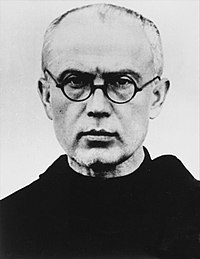
Raymund (Maximilian Mary) Kolbe was born in 1894 in Zdunska Wola, Poland, then part of the Russian Empire.  He became a Conventual Franciscan friar at age 17.  During World War II Kolbe sheltered Jews from Nazi persecution in his friary at Niepokalanow and was eventually arrested by the Nazis in 1941.  He was sent to Auschwitz on May 28th of that year.  At the end of July 1941, 3 camp prisoners came up missing.  The deputy camp commander ordered that 10 men be picked to be starved to death in an underground bunker to deter further escapes.  When one of the selected men cried out, "My wife! My children!", Kolbe volunteered to take his place.  In the starvation cell, Kolbe celebrated mass everyday and sang hymns and encouraged his fellow prisoners.  Each time the guards checked the cell, they found Kolbe either standing or kneeling and looking them calmly in the face.  After 2 weeks only Kolbe remained alive.  In order to clear the cell the guards injected Kolbe with carbolic acid to hasten his death.  His remains were cremated the following day, August 15th, the feast of the Assumption of Mary. 

Saint Maximilian Mary Kolbe


On a lighter note, a few examples of the Church's sense of humor when choosing saints' patronages, taken from our August saints.  Saint Lawrence was martyred in 258 during the persecution of the Roman Emperor Valerian.  Lawrence was burned, or "grilled" to death.  Tradition has it that he joked to his tormentors, "Turn me over, I'm done on this side."  Saint Lawrence is the patron saint of cooks and chefs.  Saint Clare of Assisi (sister of Saint Francis), who died in 1253, on one occasion was too ill to attend mass, but she was miraculously able to see and hear mass on the wall of her room.  So, in 1958 Pope Pius XII designated her the patron saint of . . . television!

And finally, this.  The Warsaw Uprising began on August 1, 1944.  The Soviet army was pushing the Germans back across eastern Poland.  The Polish underground army, or Armia Krajowa (AK), coordinated a massive operation to free Warsaw, the capitol, of German occupation to coincide with the arrival of the Soviets.  In this way the Poles could make the case for their own sovereignty to counter the puppet communist government the Soviets were preparing to put in place.  However, the advancing Russian army stopped just across the Vistula River on Warsaw's eastern side.  The Poles fought the Germans courageously for 2 months while the Russians sat and observed from the far side of the river.  Polish boy and girl scouts acted as couriers between the Polish fighting units and into and out of the besieged city, often losing their lives.  Polish civilians living in the city were killed by German artillery fire or by outright massacres at the hands of the infamous German SS troops. 

On August 5th, in two districts under German control, SS troops went house to house shooting men, women and children and burning their bodies.  Estimates of those murdered range in the tens of thousands.  The purpose of this massacre was to crush the Poles' will to fight but instead had the effect of stiffening resistance.

The German military was not prepared to fight urban guerilla warfare.  The outnumbered Poles with their well established network of barricades, street fortifications and tank obstacles effectively fought the Germans to a standstill.  However, the shortage of food and medicine took its toll.  The British were able to provide 200 low level air drops of supplies to the beleaguered Poles.  Yet, without assistance from the Soviet Army, the uprising was eventually ground down with the Poles surrendering on October 2nd. 

An estimated 150,000 to 200,000 Polish civilians died during the uprising, about 16,000 Polish soldiers were killed and about 8,000 German soldiers were killed.  About 15,000 Polish soldiers were taken prisoner.  The entire remaining civilian population of Warsaw, around half a million, was expelled from the city and of these, about 90,000 were sent to labor camps in Germany and 60,000 were sent to concentration camps.  The rest were resettled in German-occupied Poland.

The Soviets remained on their side of the Vistula River while the Germans proceeded to raze Warsaw to the ground.  Warsaw - hardly more than scorched rubble at that point -was finally "liberated" from the Germans by the Soviets in January 1945.

The old Warsaw center was entirely rebuilt after the war nearly exactly as it looked before.

Warsaw today